Homeowners' pick for appliance repair across the West
Dryer Repair — Book a Visit Today
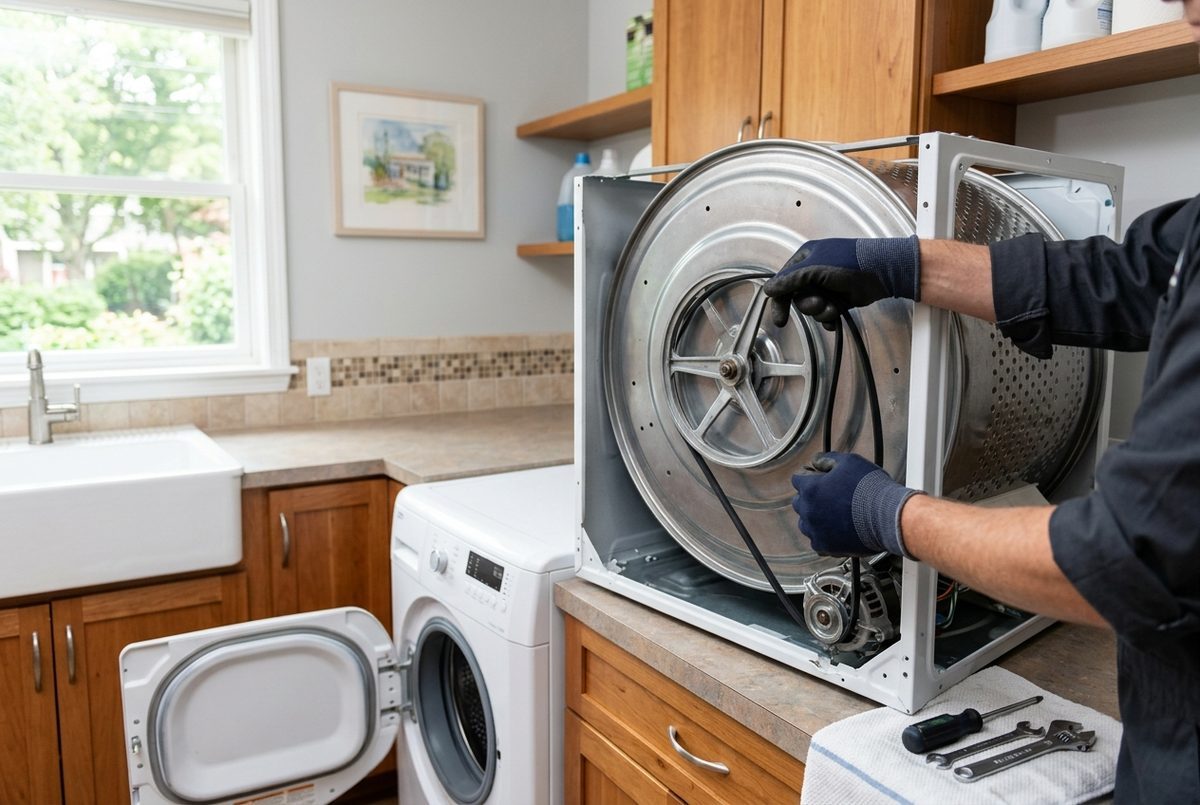
We repair gas and electric dryers, most major brands, and the usual complaint is a machine that runs without drying. Loads start taking two cycles instead of one, then three. Heat comes from an element or a gas burner, and both depend on airflow. Lint packs the vent, the thermal fuse gives up, the blower wheel cracks, or the drum belt snaps and the motor spins with nothing to turn. Worn rollers and idler pulleys start howling. When we come out we pull the dryer forward, check airflow first, then test heat, controls and the drum path in that order. You get a plain explanation of what failed and what it takes to fix it. Call us and we will find a window that fits your week.
Call (800) 712-6387- A real person answers
- Open 7 days
- Written quote before work starts
Taking calls until 5:00 PM MT
The dryer symptoms we hear most
- It runs but the clothes stay damp Blocked venting, failed heating element or gas valve coils, tripped thermal fuse
- Screeching every time the drum turns Worn drum rollers, idler pulley or rear bearing
- Won't start at all when I press the button Door switch, start switch, thermal fuse or control board failure
- The drum spins free and nothing tumbles Broken drive belt or seized idler assembly
- Smells hot and shuts off partway through Lint-restricted airflow tripping the high-limit thermostat
Safe things to check first
Worth a look before you call — sometimes it saves you the visit.
- 1Pull the lint screen and hold it under running water. If water pools instead of passing through, softener residue is choking airflow.
- 2Check the breaker panel, since electric dryers use two legs and losing one leaves the drum turning without heat.
- 3Look behind the dryer for a crushed or kinked flexible vent hose pinched against the wall.
- 4Press the door firmly shut and try starting again to rule out a latch that isn't seating.
What homeowners get from an independent shop
| Atlas Appliance Service | Big-box repair chains | Handyman listings | |
|---|---|---|---|
| You approve a written quote first | ✓ | ✕ | ✕ |
| Phones answered by people, every day | ✓ | ✕ | ✓ |
| Gas and electric, all major brands | ✓ | ✓ | ✕ |
| Independent shop, nobody's quota | ✓ | ✕ | ✓ |
| Techs who know the local housing | ✓ | ✕ | ✓ |
What homeowners say after the visit
“The tech double-checked gas connections before leaving even though the job was electric. Careful people.”
Lois W.Peoria, AZ“From first call to spinning drum, under 30 hours. Everything in writing.”
Cole R.Eugene, OR“They serviced the rental across town and sent photos of the finished repair. Perfect for a landlord.”
Meg A.Tempe Junction, AZDryer Repair — quick answers
Why does drying take three cycles now?
Almost always airflow. Lint builds up inside the vent run, not just the trap, and hot wet air has nowhere to go. Heat may also be weak from a partly failed element. We measure both instead of guessing at one.
Do you work on gas dryers?
Yes. Gas models use igniters, flame sensors and valve coils, and each fails in its own way. We test the ignition sequence, check the gas connection for leaks and confirm the burner cycles properly before we finish up.
Is a noisy dryer safe to keep using?
Grinding and squealing mean parts are wearing metal on metal. Running it that way can damage the drum or seize the motor. Better to stop using it and have the rollers, pulley and belt looked at first.
Can hard water hurt a dryer?
Not directly, but well water and heavy softener use leave film on lint screens and clothing. That film blocks the mesh and starves airflow. Washing the screen every few months makes a real difference in dry times.
Should I clean the vent or replace the dryer?
Clean the vent first. Many dryers written off as worn out simply cannot exhaust. We check duct length, elbows and the exterior hood, then tell you honestly whether the machine itself has real problems.
How long does a typical dryer visit take?
Most repairs are handled in one appointment. Diagnosis is quick because dryers have fewer systems than washers. If a part must be ordered, we explain what it is, secure the machine and schedule the return visit.
How it works
- Step 1
Tell us the symptom
Call us or fill out the form and describe what you hear, smell, or see. A noise, a leak, an error code, the smell of something burning. Small details help us load the right parts on the van before we head out.
- Step 2
We come look
A technician comes to your home and tests the machine instead of guessing at it. You'll hear what failed, what the fix takes, and what we'd do if this were our own kitchen.
- Step 3
Repair and check
A lot of parts ride with us, so common failures get handled on the same visit. Harder parts we order in. Then we run the appliance through a cycle and make sure the problem is actually gone.
- A real person answers
- Open 7 days
- Written quote before work starts
Why homeowners call us
- Western conditions, plainlyHard well water scales up dishwasher jets and water heater lines. Summer heat leans on refrigerator compressors. Cold garages freeze washer valves in winter. We see those patterns weekly, so we check for them before chasing something exotic.
- Brand independentWe aren't tied to any manufacturer. That means we work on the mixed lineup most homes actually have: one brand of range, another brand of laundry, a fridge somebody bought used. Same technician, same visit.
- Steady, not rushedRushing is how a diagnosis goes wrong. We take the time to pull the panel, test the part, and read the board. And if a repair doesn't make sense for the age of the machine, we'll say so out loud.
- Straight schedulingYou get a real appointment window and a heads-up when the technician is on the way. Rural addresses and long mountain driveways are normal for us. Tell us about the gate or the gravel and we'll plan for it.
- All major brands, gas & electricIndependent service on Whirlpool, LG, Samsung, GE, Maytag, Bosch, KitchenAid and the rest.
- Straight answersSome machines aren't worth the part, and we say so before you spend anything.
Dryer Repair
Small faults become big ones on a schedule of their own
Describe the symptoms and we'll book the visit — takes about a minute.
- A real person answers
- Open 7 days
- Written quotes
- All major brands
- Gas & electric
Rather not call? Get a free quote →